
Prai Ijing Village Sumba 2027: How a Respectful Hilltop Village Visit Actually Works
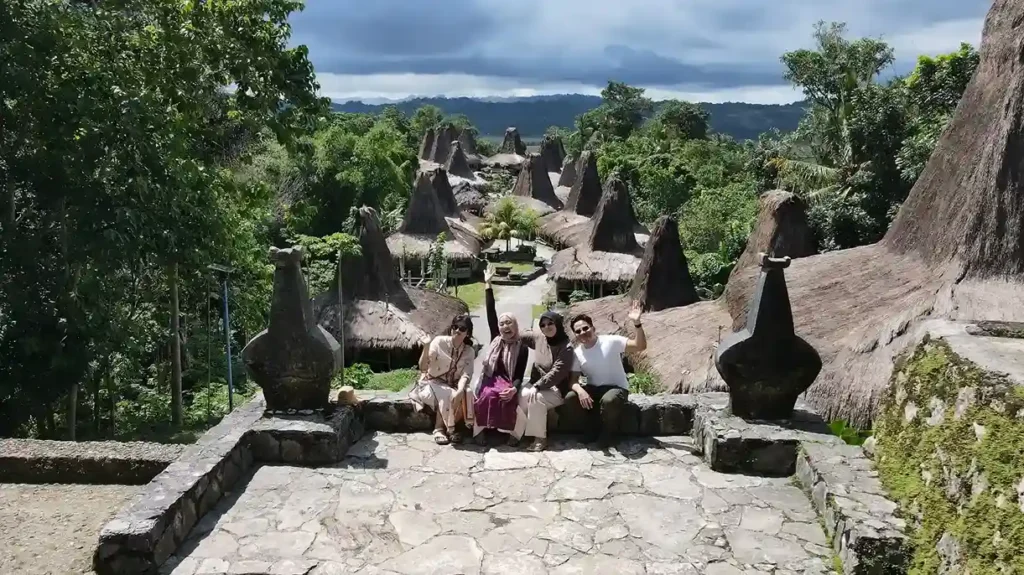
A visit to Prai Ijing village Sumba works properly when you do one thing before anything else: report to the village and greet the elders or the kepala adat, then start walking only once you have been welcomed. Everything visitors ask about — the peaked roofs, the stone graves, where you may stand, whether you can photograph — follows from that first courtesy.
Prai Ijing (also written Praijing) is a hilltop prai ijing traditional village on the edge of Waikabubak in West Sumba — one of the easiest west sumba traditional villages to reach, which is why it needs the most visitor discipline. We are a local Sumba desk in the IndonesiaJuara network, and this is the protocol our driver-guides apply.
Where Prai Ijing sits, and how long the drive really takes
From Tambolaka Airport (TMC), the honest planning figure is 1 to 1.5 hours of driving. That is real time, not brochure time: the road is mostly sealed but narrow, with patchy asphalt, motorbikes, dogs, and school traffic through the villages en route. In heavy rain it is slower.
That proximity makes it the first village most people see after landing, before the longer runs to the Kodi coast (2 to 2.5 hours) or across the island to Waingapu (a full day of driving). Visitors who learn the etiquette here carry it onward.
Allow 1 to 1.5 hours inside the village itself. That is enough time to report in, be welcomed, walk the hilltop properly, and sit for a while — and it is the figure we block out in every itinerary, separate from the drive.
How to visit Sumba traditional villages: the right order
A guided village visit sumba is not a walking tour with commentary. It is a request to enter someone’s home ground:
- Report first, walk second. The guide takes you to the elders or the customary leader, explains who you are and how many, and waits for the welcome.
- Stay on the paths offered. Do not cut between houses, step over offerings, or wander into the ceremonial centre alone.
- Do not climb. Never sit, stand, or pose on a tomb, and do not step onto a house veranda unless invited up.
- Dress covered. Shoulders, midriff, and thighs. This is not a beach and not a photo set.
- Ask before every photograph of a person, and put the camera away around prayers, offerings, and ritual preparation.
- Give your contribution through the guide, discreetly, to the village representative — not as cash handed to children.
The tombs are graves; the verandas are where families sit. Neither is furniture.
Reading the village: uma mbatangu houses and the stone tombs
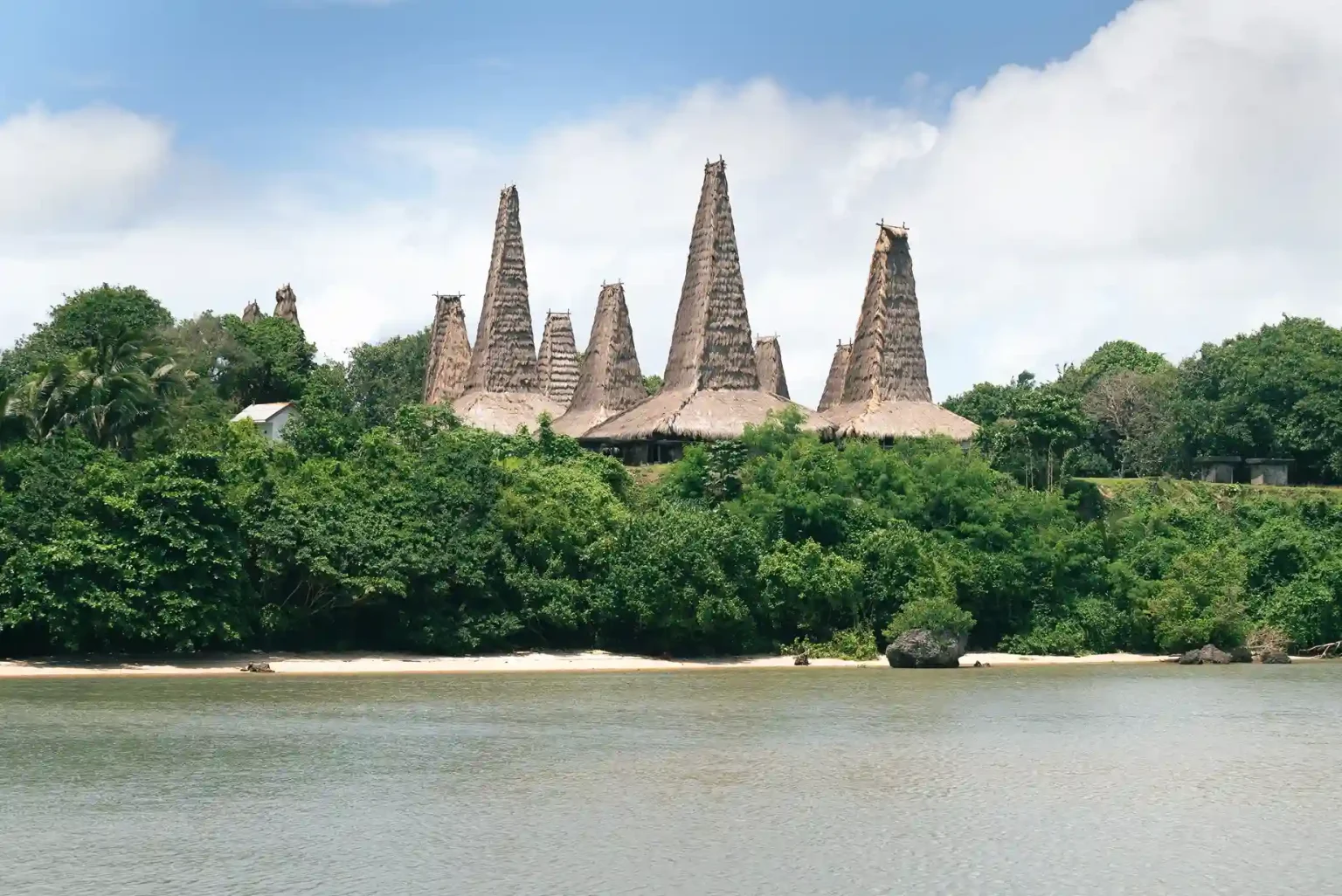
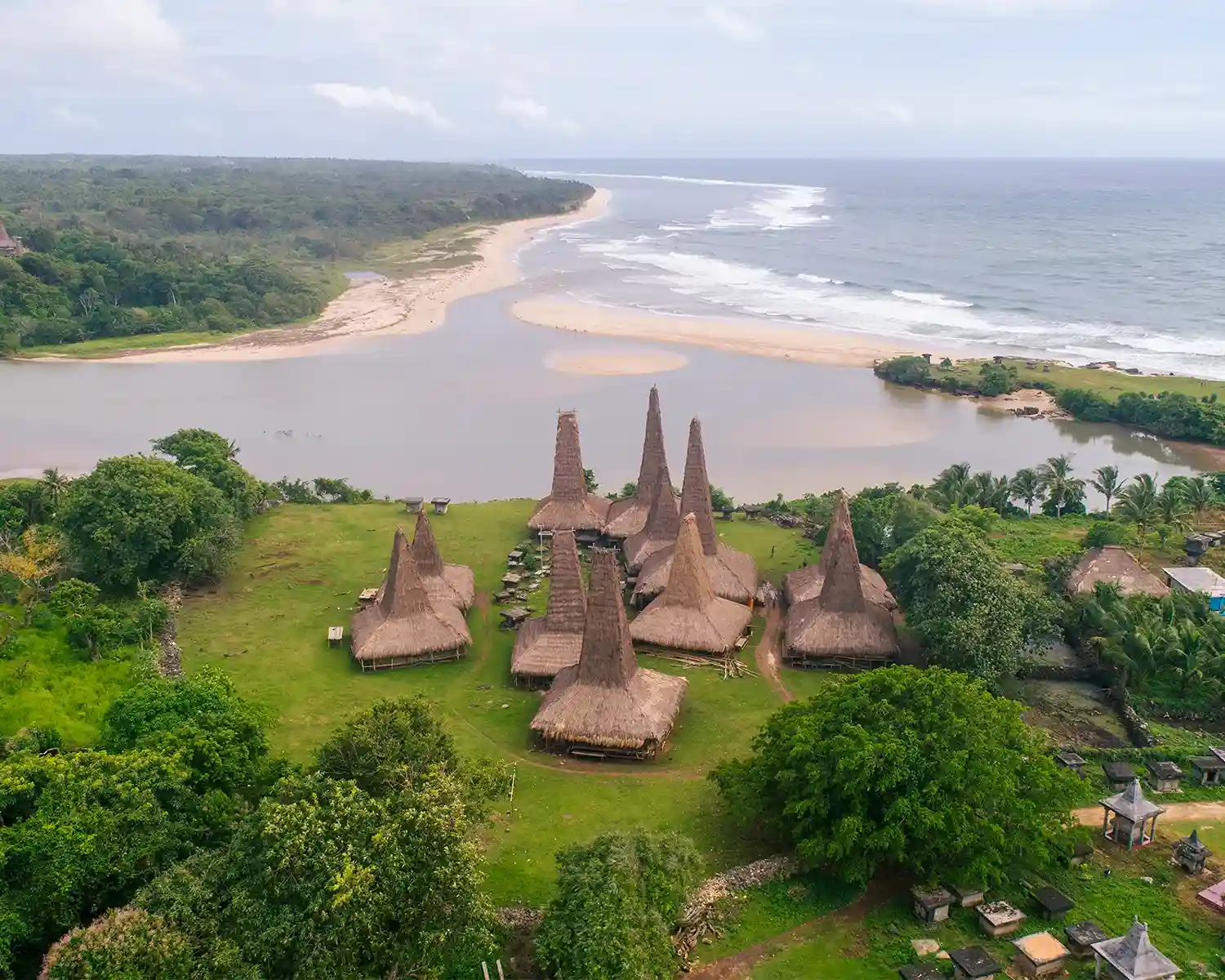
The sumba peaked roof houses here are uma mbatangu — tower-houses with a central peak rising out of the roof. They stand on stilts, and the vertical order is functional. Traditional houses in sumba read in three to four levels: livestock below the floor; the family living area and hearth in the middle; storage kept dry above the smoke; and the tower peak as ancestral space, not for casual visitors.
Roofs are thatched in alang-alang grass, and peak height carries meaning: taller towers signal clan standing and respect paid to ancestors. A roofline here is a statement about lineage, not a style choice. One detail surprises people expecting a tidy heritage site — Prai Ijing’s layout is not uniform, with houses at irregular angles across the hilltop. This is a settlement that grew, not a reconstruction that was designed.
Table-like sumba stone megaliths sit among and in front of the houses. Prai Ijing is known for a king’s tomb reported at around 40 tons, buried according to local accounts with pigs and woven cloth. Across the megalithic villages sumba is famous for, these stones are not monuments to a finished past: funerary obligations are ongoing and still shape family economics.
Marapu is a living religion, not folklore
Marapu is Sumba’s ancestral belief system: an indigenous religion centred on ancestor spirits and unseen beings that mediate with a remote high deity. It is not legend or costume. Many Sumbanese are officially registered as Christian or Muslim and still observe Marapu ritual — coexistence rather than contradiction.
This changes what Prai Ijing is. The houses are homes and places of worship at once, and the stones are ritual sites with live obligations. You are walking through a working sanctuary that also has laundry on the line. Marapu is not dying out; it is under pressure and resilient.
Photography and donations: the two things visitors get wrong
Photography is generally accepted at Prai Ijing and other waikabubak cultural sites, with conditions. Landscape and architecture are usually fine; people are not. Ask every time, accept a refusal without negotiating, and stop shooting around prayers and anything involving a priest. Drones over a village or ceremony are a straightforward no.
On contributions, the customary form is sirih pinang — betel leaf and areca nut — which your guide should carry and present for the group. Alongside it, a modest cash contribution per group, given discreetly through the guide to the adat representative, is normal. Amounts are not fixed and not posted on a board.
What does real damage is cash pushed at children: it teaches a village that visitors are a lottery and undermines the elders’ authority over village funds. Better to buy something — ikat cloth, carvings — at a fair price without grinding the seller down. A serious weaving holds weeks of skilled work.
When to come: green grass, dry roads, and Pasola
December to March is when the savannah is genuinely green and the hills around Waikabubak look the way they do in photographs. It is also the wet season: heavier showers, softer access roads, slippery trails. June to September gives reliable roads and predictable driving times, but dry gold-brown grass. Photographers take the green; travellers with tight connections take the dry.
Pasola, the ritual horseback spear festival of western Sumba, falls roughly across February and March in Lamboya, Wanukaka, Gaura, and Kodi. Dates are set by the arrival of the nyale sea worms and confirmed locally each year, never fixed in advance. If Pasola is your reason for coming, plan through our private Pasola festival departure for 2027, built around that uncertainty rather than pretending it away.
How Prai Ijing fits into a private Sumba trip
Prai Ijing is a half-morning, not a day. On our private 6D5N Sumba trip it sits early in the West Sumba portion, before the itinerary moves to the coast and across the island — the routing that avoids backtracking.
Rates for the 6D5N run start from USD 1,060 per person (indicative) based on a group of eight, confirmed per date, group size, and accommodation tier. One thing we state openly: the per-person price rises at five guests and again at nine, because a second vehicle is required from six to ten. Groups of four and eight are the sweet spots. Ground handling covers the private vehicle and driver-guide, fuel, parking, customary donations at villages, drinking water, and coordination from the Tambolaka Airport (TMC) meet to final drop-off; accommodation tier, flights, and personal expenses are quoted separately. Treat that figure as indicative only and message us to confirm the current rate for your dates before you budget or book.
If you already have an itinerary and only need driving, access, and village protocol handled, that is our Sumba ground operator service. The wider network product and rate card sit with IndonesiaJuara, holder of the TripAdvisor Travellers’ Choice Award for three consecutive years — 2023, 2024, and 2025, in the top 10% of businesses worldwide.
Frequently Asked Questions
Do I need a guide to visit Prai Ijing village in Sumba?
Practically, yes. The reporting-in, the greeting, the sirih pinang, and the customary contribution all need someone who knows the village and speaks the language. Arriving alone usually means a rushed walk-through or a breach of protocol you never notice.
How far is Prai Ijing from Tambolaka Airport?
Plan 1 to 1.5 hours by road. Prai Ijing sits on the edge of Waikabubak, and the drive from Tambolaka (TMC) is on the main sealed road, narrow in stretches and slower in rain.
Is there an entrance fee at Prai Ijing?
There is a customary contribution rather than a posted ticket price, and amounts are not fixed. On our trips it is covered in the ground-handling inclusions and presented by the guide, so guests are not negotiating at the gate.
Can I take photographs at Prai Ijing?
Landscape and architecture photography is generally accepted; photographs of people require asking each time. Stop entirely around prayers and ritual preparation, do not fly drones over the village, and never climb a tomb or house platform for an angle.
What should I wear to a traditional village in Sumba?
Modest clothing with shoulders, midriff, and thighs covered, plus shoes for uneven stone and packed earth. Beachwear and open sarongs are the most common mistake among visitors arriving straight from the coast.
Is Prai Ijing better than Ratenggaro?
They do different jobs, so most west sumba village tours include both. Prai Ijing is the accessible hilltop village near Waikabubak with an irregular layout and the reported 40-ton king’s tomb; Ratenggaro is the clifftop Kodi village with the island’s tallest tower roofs, 2 to 2.5 hours from Tambolaka.
Plan your Prai Ijing visit with a local Sumba desk
Tell us your dates, group size, and whether you are chasing green savannah or dependable roads, and we will build the village sequence around it — protocol handled quietly at every gate, and an indicative quote confirmed against current rates.
WhatsApp: https://wa.me/6281139414563
Email: [email protected]
Keep Reading
Best Luxury Cruise Indonesia After Sumba: 2026 Guide
After a week among Sumba’s sandalwood horses, megalith villages and waterfall pools, the natural next leg is the sea. The best luxury cruise in Indonesia for…
Weekuri Lagoon Sumba 2027: A Kodi Coast Day Plan With Mandorak and Ratenggaro
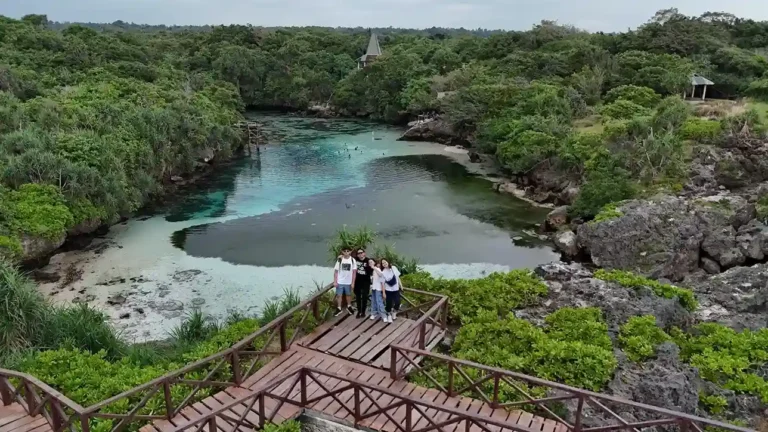
Weekuri Lagoon sits on the Kodi coast of Southwest Sumba, about 2 to 2.5 hours by road from Tambolaka Airport, and the sensible way to see…

Wairinding Sunrise Viewpoint 2027: Timing the Light and the Horses on East Sumba’s Ridges
The Wairinding sunrise viewpoint is a run of grass ridges inland from Waingapu, about 1.5 to 2 hours by road, so catching first light means leaving…
Planning a Trip to Sumba?
Two trips across the island — shared on a fixed date, or private on yours.